
LGT Private BankFront Workbench
UX/UI Designer (APAC lead)
Search
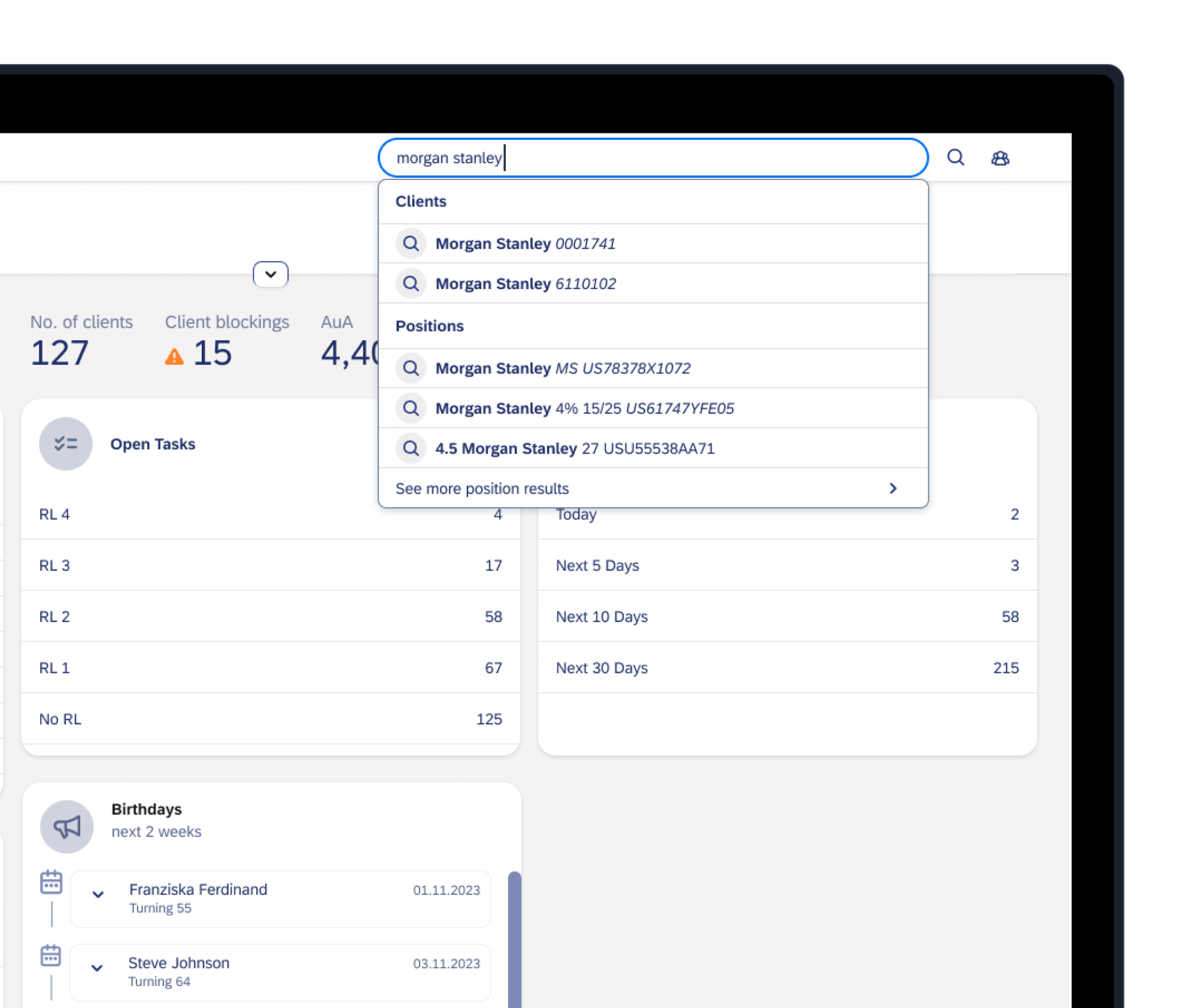
Optimises search to find client records in seconds
Overview
With its headquarters in Liechtenstein, one of the smallest countries in Europe, LGT, is the largest royal family-owned private banking and asset management group in the world. Front Workbench was to be the private bank’s signature internal platform – combining all internal apps from the LGT eco-system into one single app used across Europe and Asia for front office staff.I was one of a team of four designers (1 in APAC, 3 in Europe) who was brought onboard to help create a platform that was to be the go-to-tool for Relationship Managers and their assistants so that they could track and monitor their clients’ accounts and activites. To entice the Private Bank’s 500+ RMs to use yet another new system is the biggest challenge, especially since the old system will not be demised. The difference in needs between the users of the two regions also meant different applications would need to be built to cater for the different requirements.
Role:
UX/UI Designer
User research
System audit
Prototyping
User testing
Usability testing
Team:
Product ownersBusiness analystSolution architectFull stack devs
Software tester
Local topic owners
Duration:
4 months
- Discover
Research and feedback revealed these key issues:
One of the most critical pain points users faced was the inefficient search functionality. The current search feature lacked proper indexing, leading to slow and inaccurate results. For example, searching for a name like "Eric" would display hundreds of irrelevant entries—even when the user knew only one client by that name existed in their records.
Through user interviews and a heuristic audit of the existing app, we identified key gaps in the search experience. Competitor analysis further highlighted how other platforms handled advanced filtering and search enhancements, revealing clear opportunities for improvement.
Redesign Goals
To build a viable MVP, we prioritized making search functional at a foundational level. After initial findings from both APAC and EMEA, the decision was to focus on ensuring users could reliably find clients by name and position. Our key objectives were:
- Improve speed and accuracy by refining search indexing.
- Minimize irrelevant results through better filtering.
- Lay the groundwork for future enhancements like advanced filters or predictive search.
User interviews
To gain an understanding of:
- what are the pain points of the current search function in the core banking app
- what ‘work around’ methods are being used to complete searches
- what are the end goals of each keyword search
Competitor analysis
To gain an understanding of:
- how search is being executed in the competitive landscape
- how advanced features are being used in other products
Customer journey mapping
To gain an understanding of:
- users’ current pain points
- user’s needs, goals and motivations
- user’s touch points and interactions
So that I can:
- identify capabilities to further enhance the user experience to the product
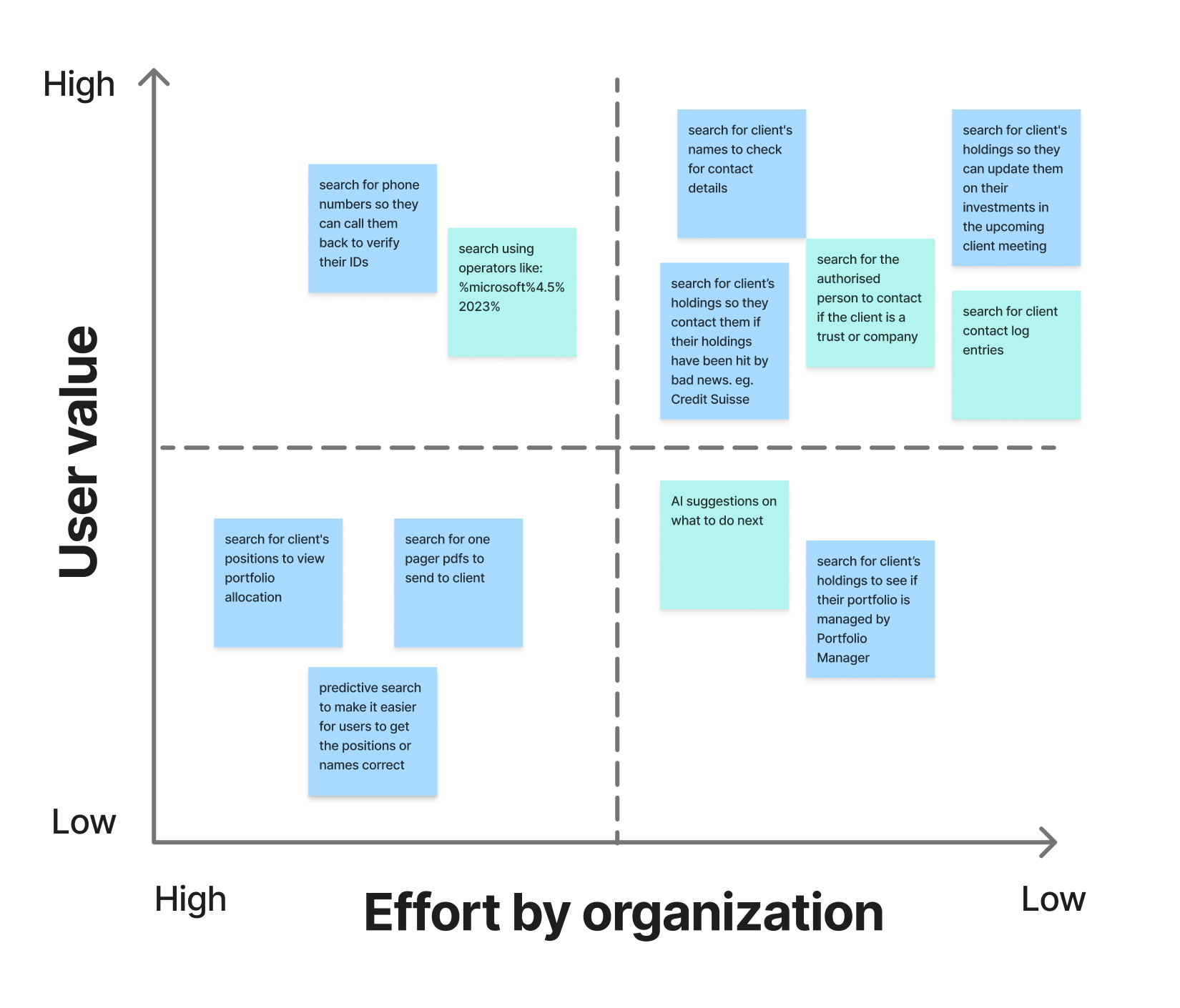
Prioritization Matrix
Aligning the team and stakeholders
on the MVP scope.
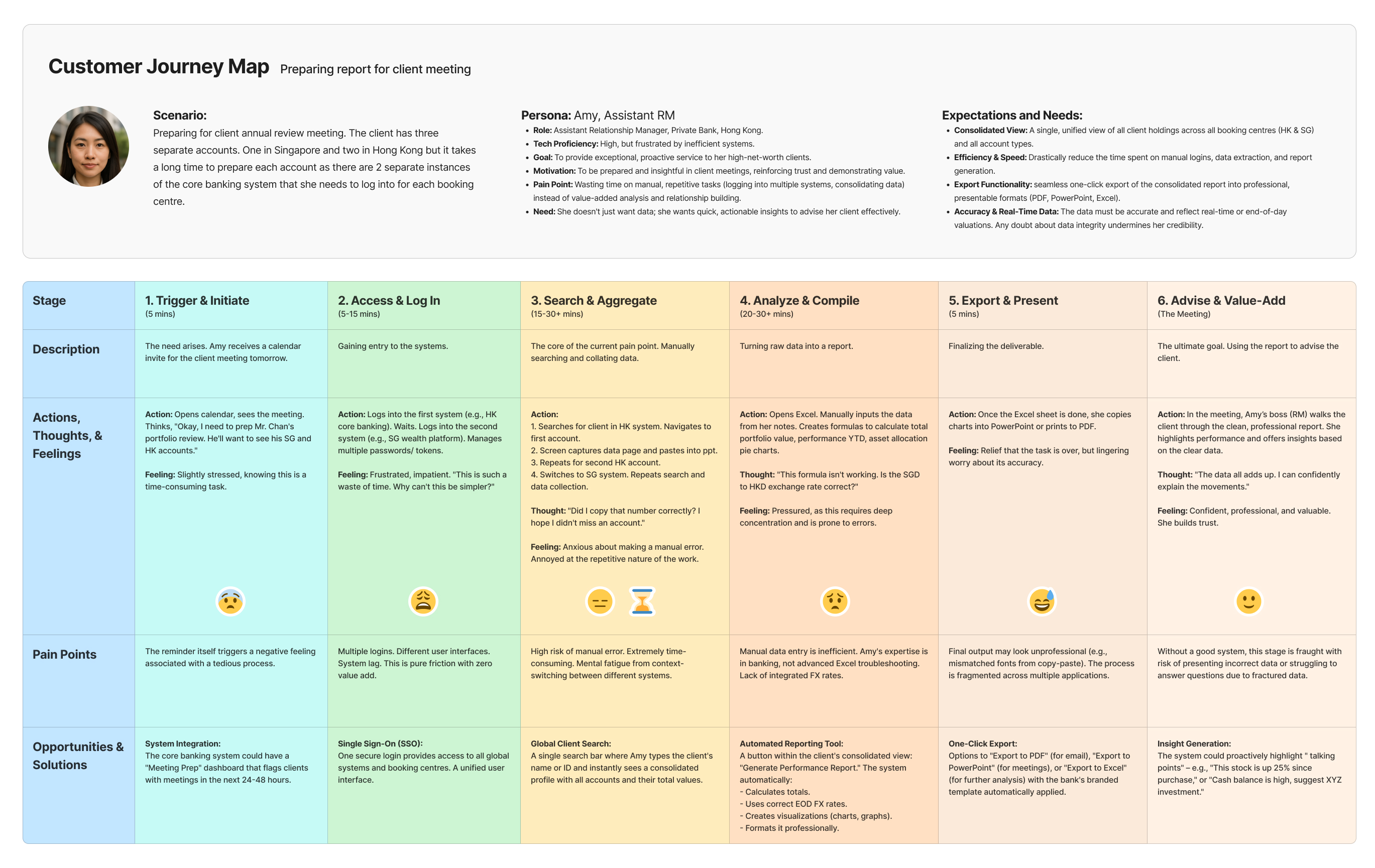
Customer Journey Map
Understanding the current process, identifying pain points and opportunities for improvement.
- Define
There were 3 problem areas which I managed to define:
Finding issuers and positions quickly is slow and inefficient, especially if clients have more than one account in different countries
Problem #1
Finding a client’s name, in order to track their portfolio or to retrieve other personal details, is an arduous task
Problem #2
Searching for a client’s name with a phone number is challenging because the current system isn’t indexed to search by numbers
Problem #3
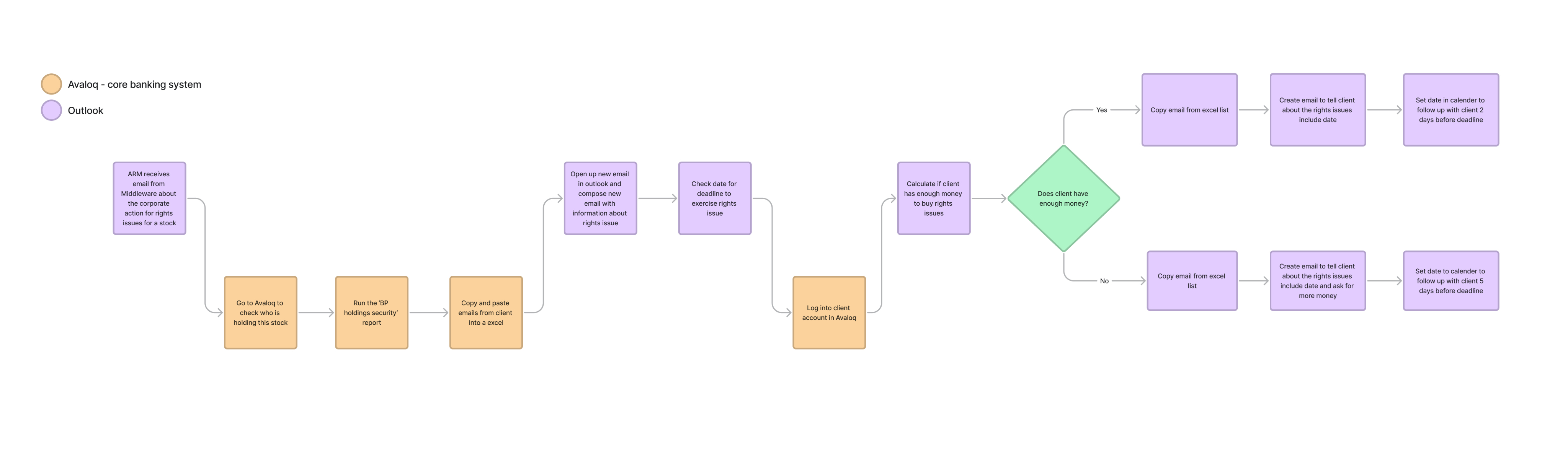
Mapping the current search for clients process flow
Analysing the existing journey for informing clients about corporate actions
“If I am looking for quick information on just one bond, I have to open bond finder, punch ISIN, generate pdf, save pdf and then use pdf. It’s cumbersome...”
- Develop
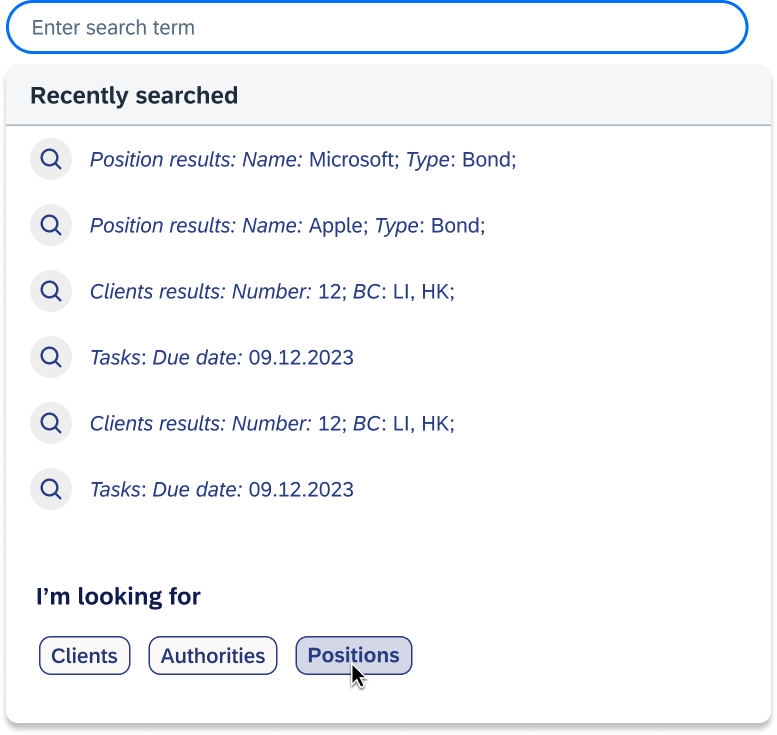
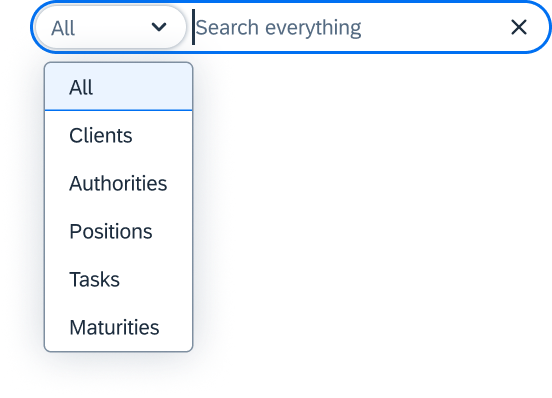
Based on research insights, I developed wireframes to explore various search refinement approaches and validated them through usability testing.
Advanced search - filter chips
Advanced search - dropdown filter
- Deliver
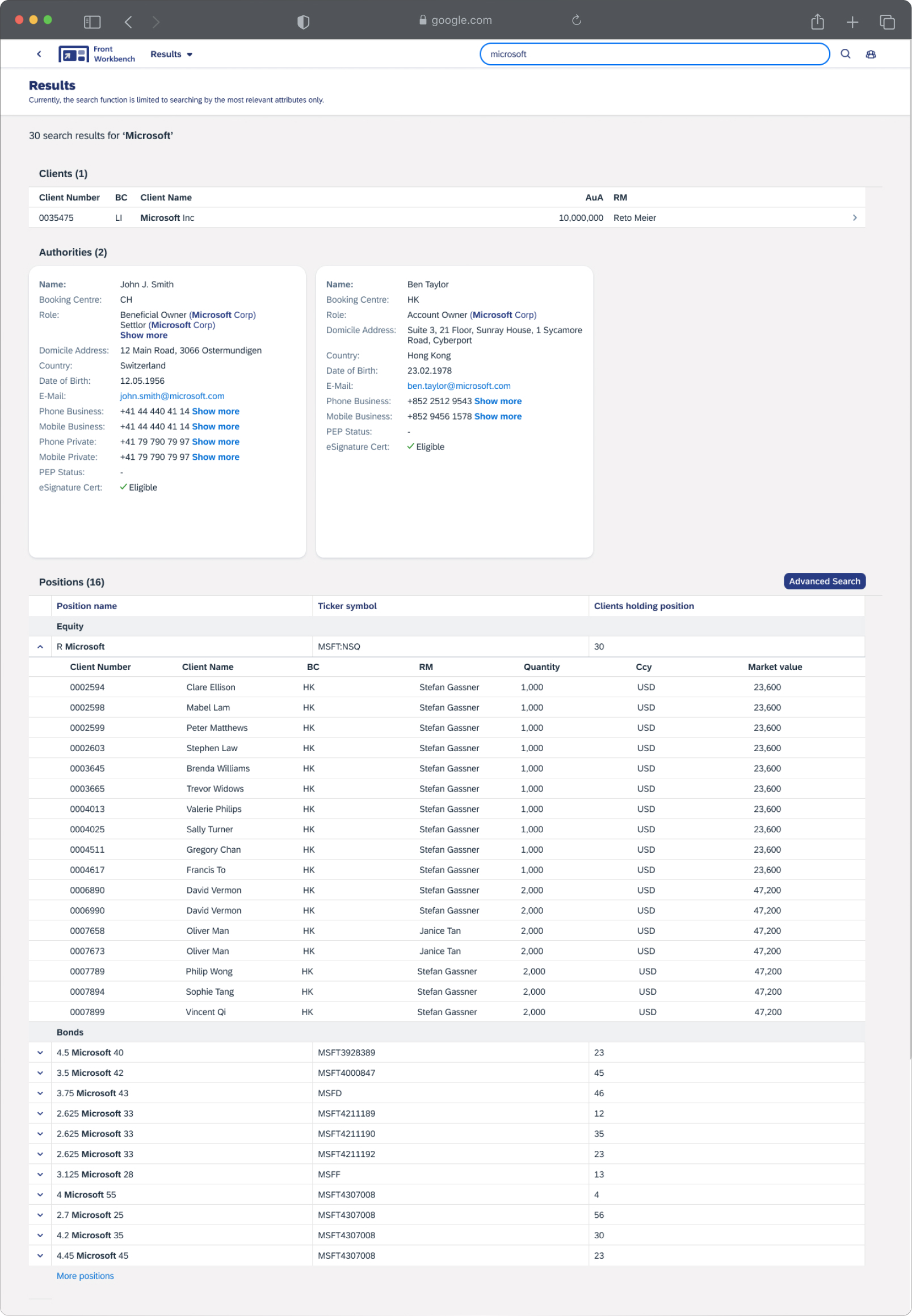
For Front Workbench’s search functionality, the MVP launch focused on the essentials: enabling users to quickly locate clients and contacts by name. This foundational feature streamlined workflows for front office staff, allowing them to retrieve key information without further manual sifting.
Based on direct feedback from users, the post-MVP enhancement prioritised position-based search—a frequently requested capability especially for handy for dealing with corporate actions. Collaborating closely with the engineering team, we expanded the search algorithm to index and prioritise position data, aligning the tool with real-world hiring workflows.
The impact was immediate: user engagement with search increased by 90% after the post-MVP update, with position searches becoming the most-used filter. By addressing this need, Front Workbench not only improved efficiency for users but also reinforced its role as a platform built around user-driven innovation.
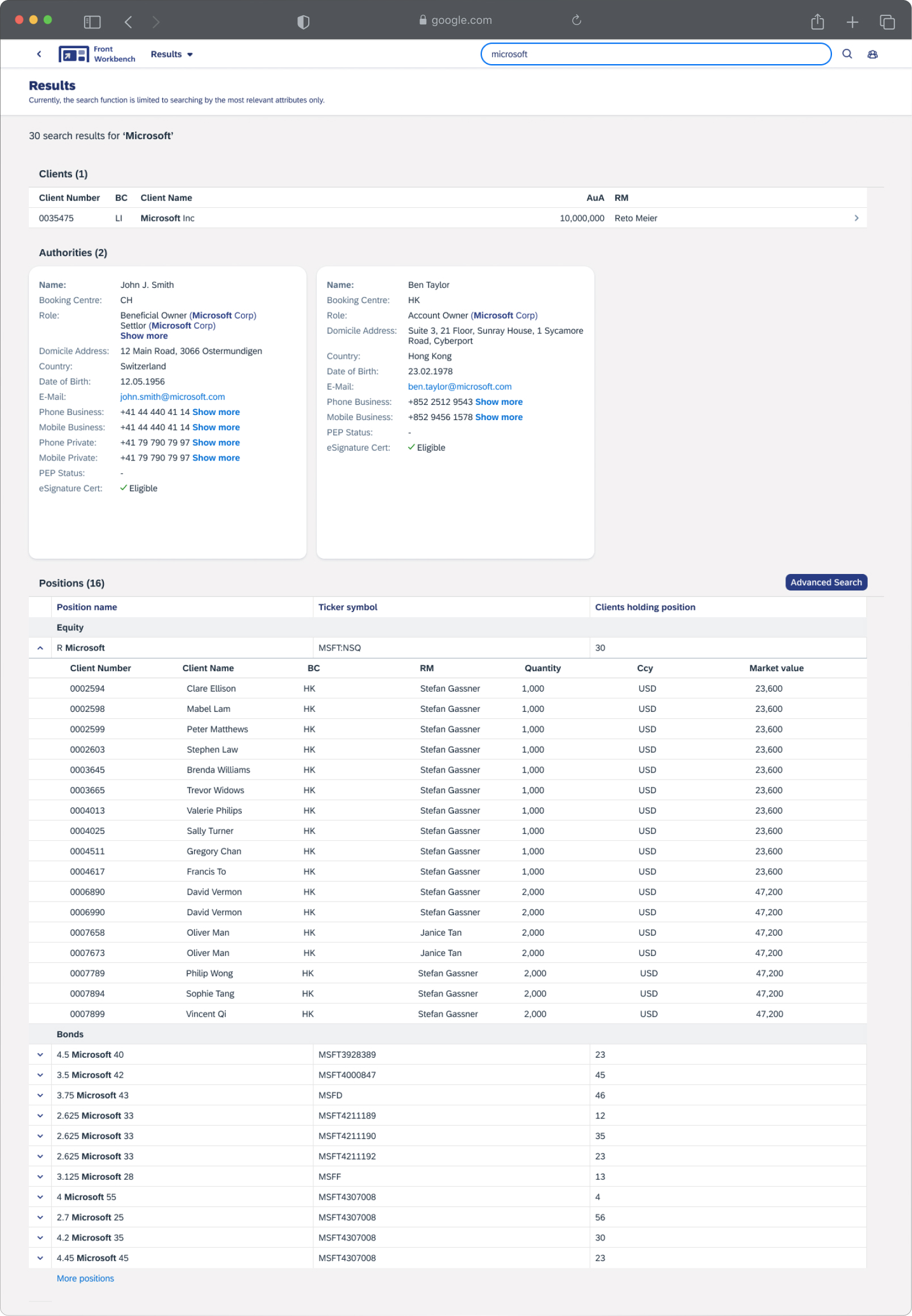
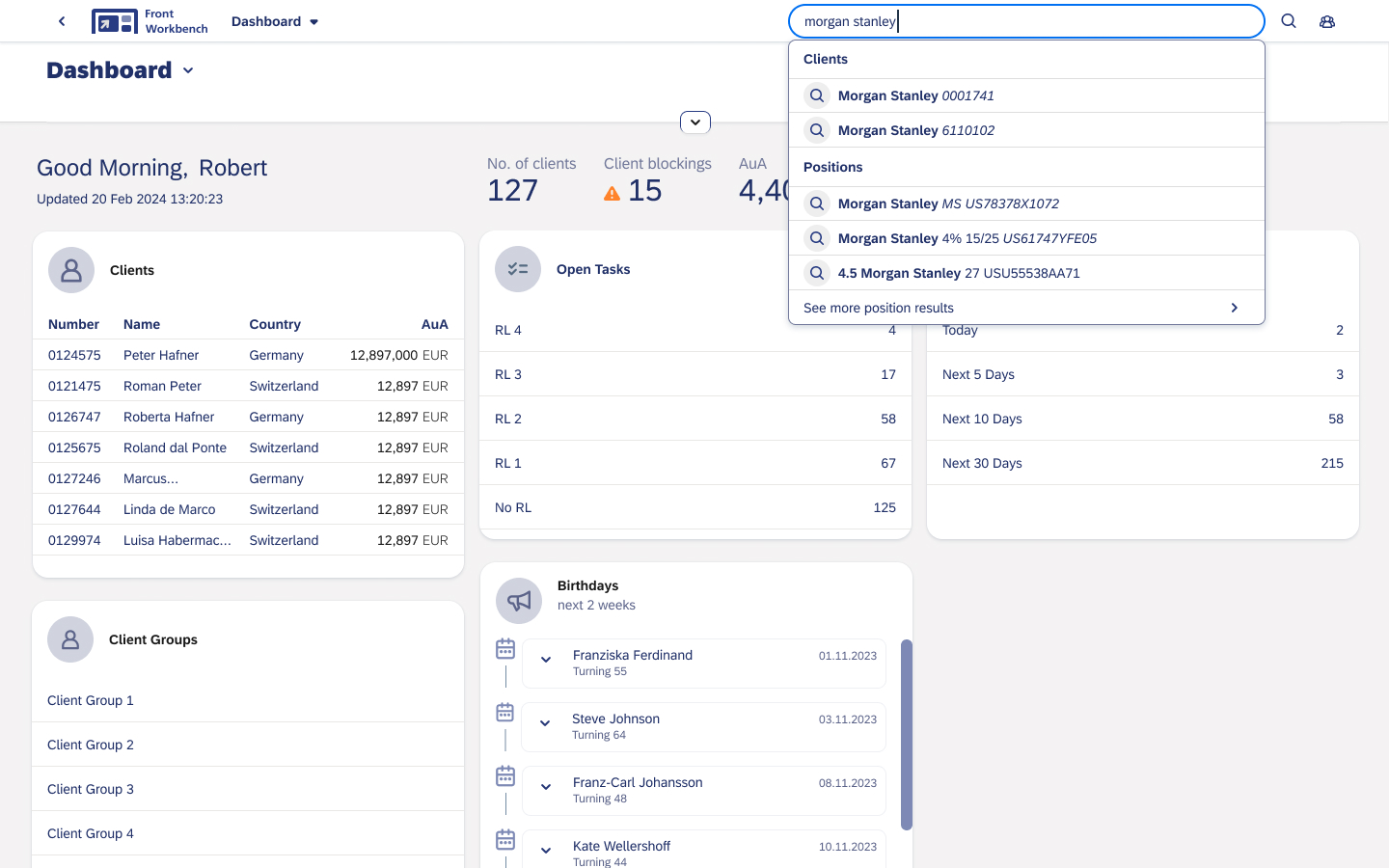
Search results page
Displayed results grouped into categories: clients, authorities and positions.
90%
adoption in 2 weeks
(vs. Avaloq’s search)
85%
first-result accuracy
(vs. <10% in Avaloq)
5x more
searches per day/user
Saved
500+ hours
in advisor time
- Next steps
Following the post-MVP launch, additional enhancements were prioritised based on ongoing user research and feedback. Key initiatives for the future roadmap include:
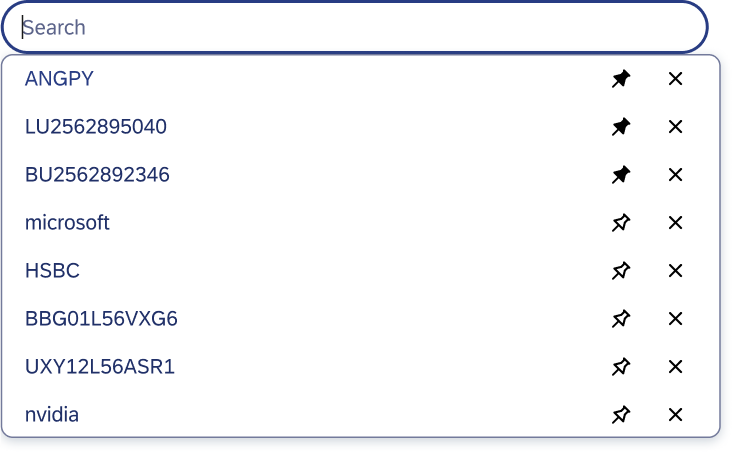
- Saved & Pinned Searches: Developing functionality to save recent searches and allow users to pin frequently used queries for quick access.
Recent search history andpinning search
Developing functionality to make it easier for users to save, pin, and quickly revisit frequent queries—eliminating repetitive manual input.
- Number-Based Search Optimisation: Conducting user surveys across both APAC and EMEA to identify common numerical search patterns (e.g., IDs, invoice numbers) and analyse pain points in existing workflows.
Number based research findings
Finding #1
Inconsistent functionality across different platforms
Users had to learn the UX of different systems in order to navigate their way round each system.
Finding #2
Too many work arounds
It was difficult to complete a straight-forward search from existing apps.
Finding #3
Poor indexing
The search results are very much irrelevant and would result in hundreds of unmatched results. Also, much of the personal data hasn’t been migrated to the existing system so users aren’t able to search for phone numbers and email addresses.
Finding #4
Text selection disabled
For security reasons, highlighting and copying has been disabled in existing systems - making it difficult for users to complete simple tasks which would been completed on an ordinary system.
Implementing enhancements for the search feature, based on these insights, would eliminate manual effort, freeing up time for users to focus on higher-value client activities.
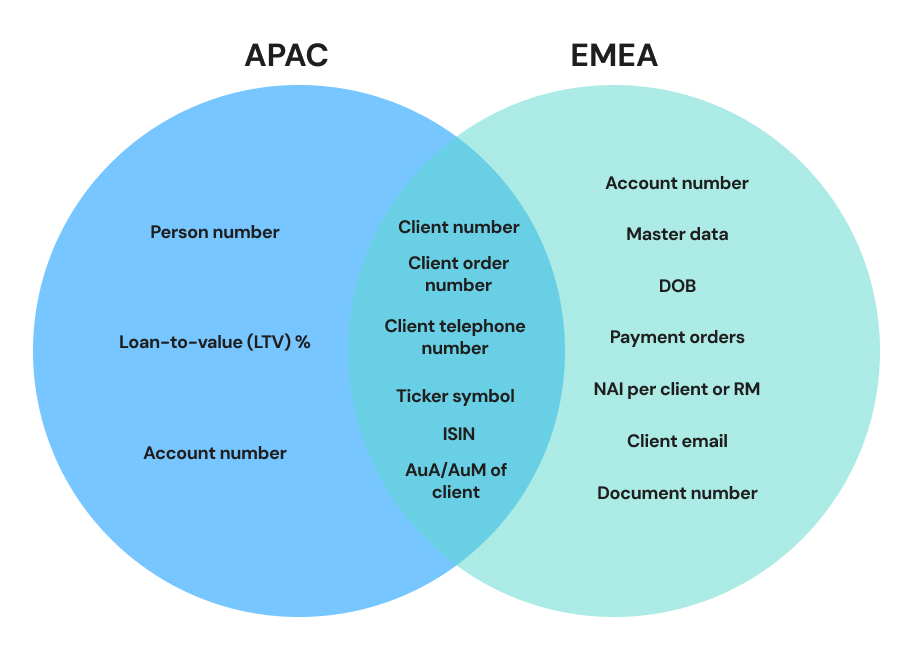
Number search data findings
Understand the common scenarios that Front users search for using numbers within LGT
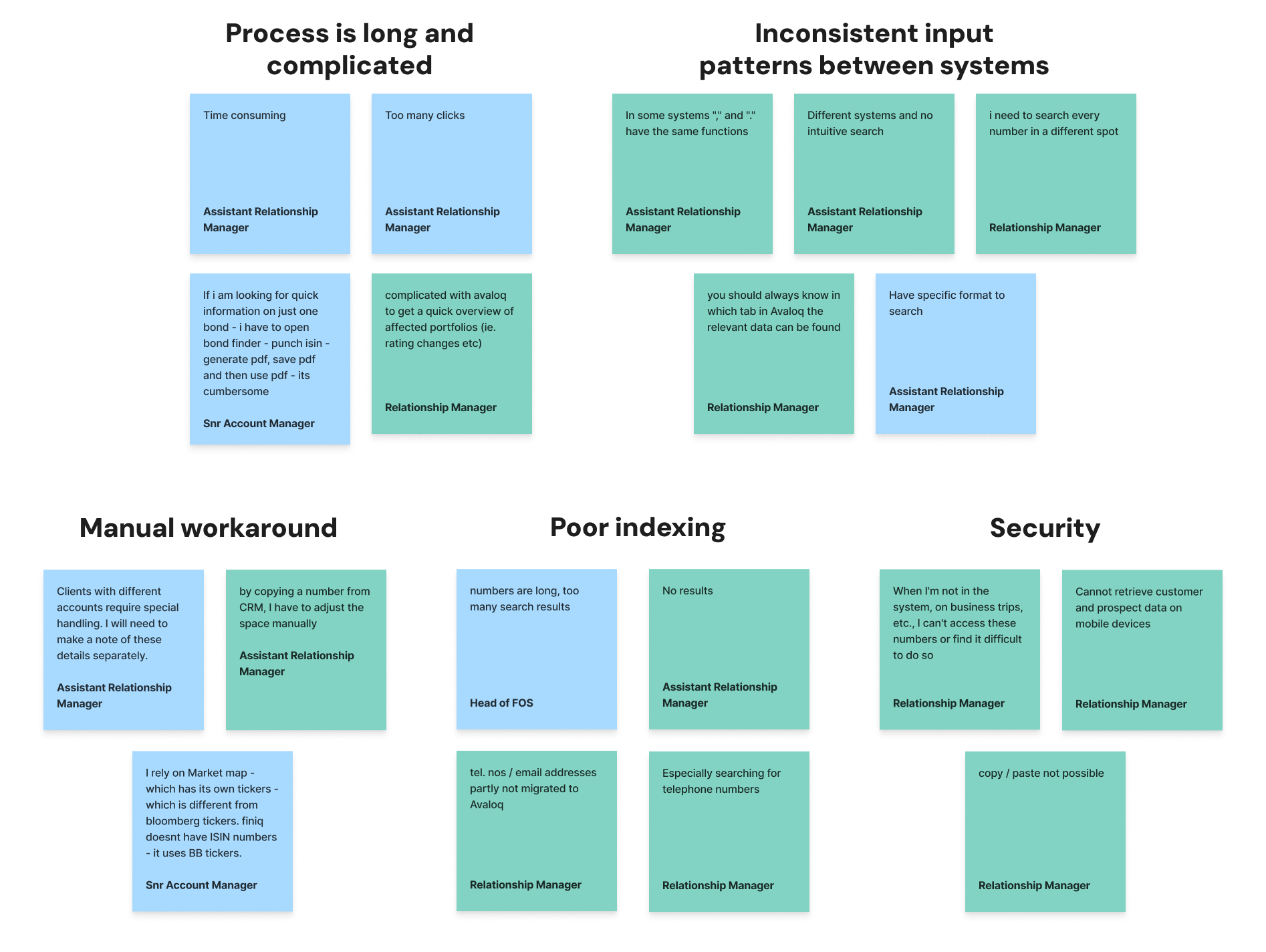
Affinity map of survey results
Grouping pain points from Front users from both regions.
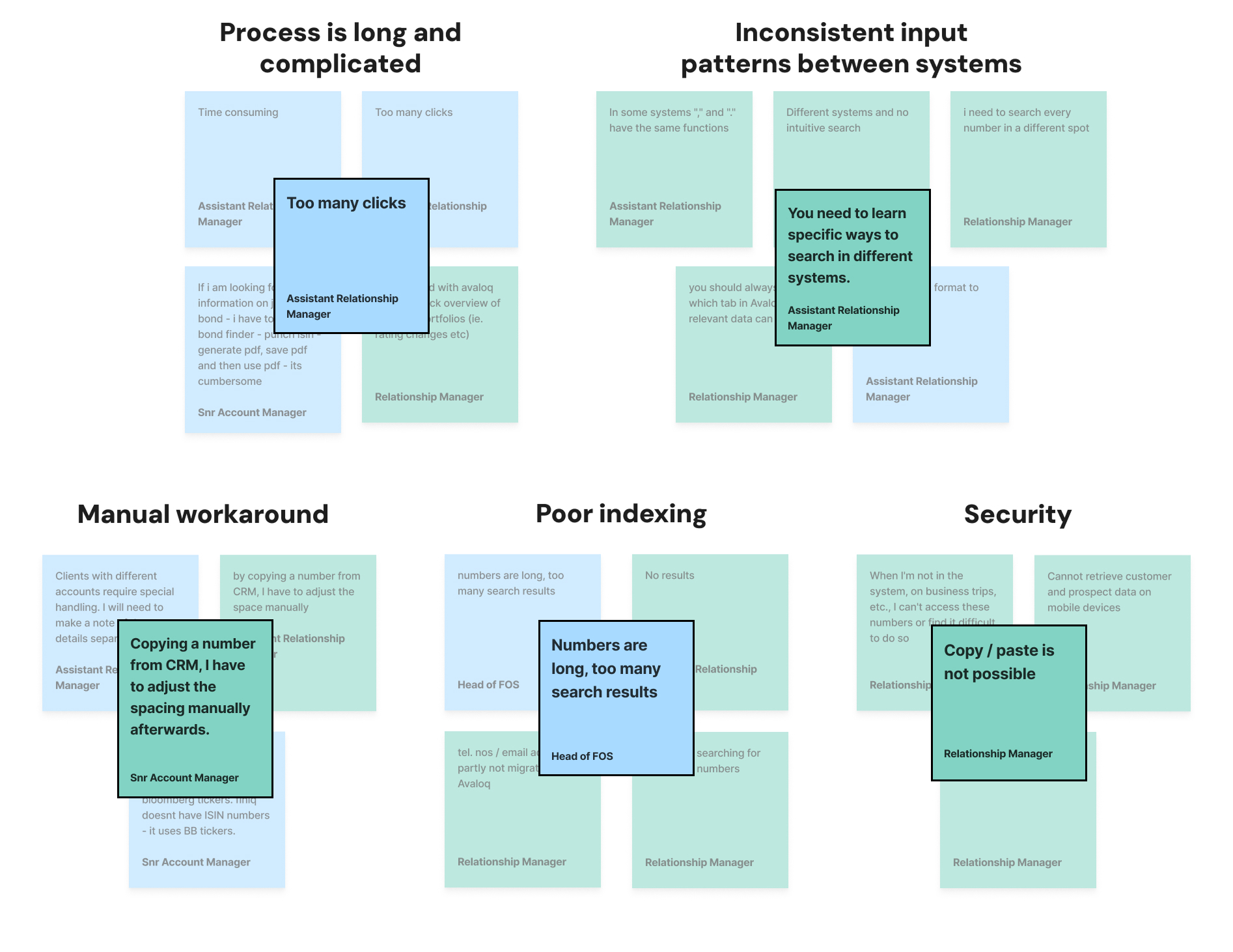
The primary pain point and user need from each affinity group was captured by a single, pivotal user quote.
Other features on Front Workbench:
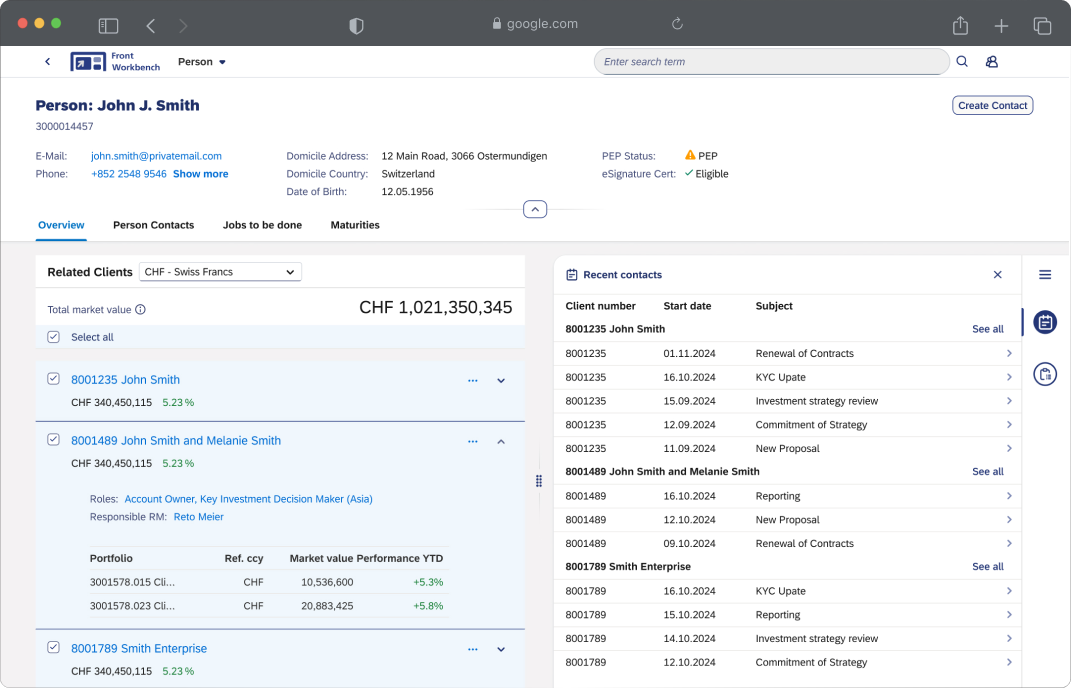
Person view page
A holistic view of a client’s accounts on one page, eliminating hours of manual calculations
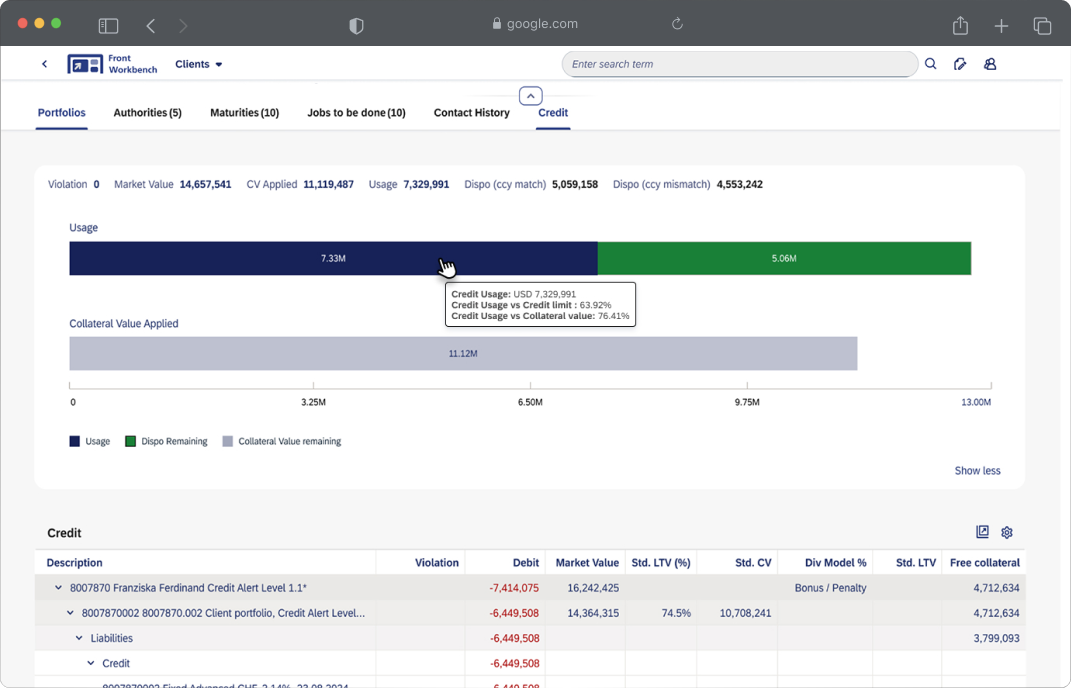
Credit
Smarter monitoring of client’s assets to prevent losses before they happen
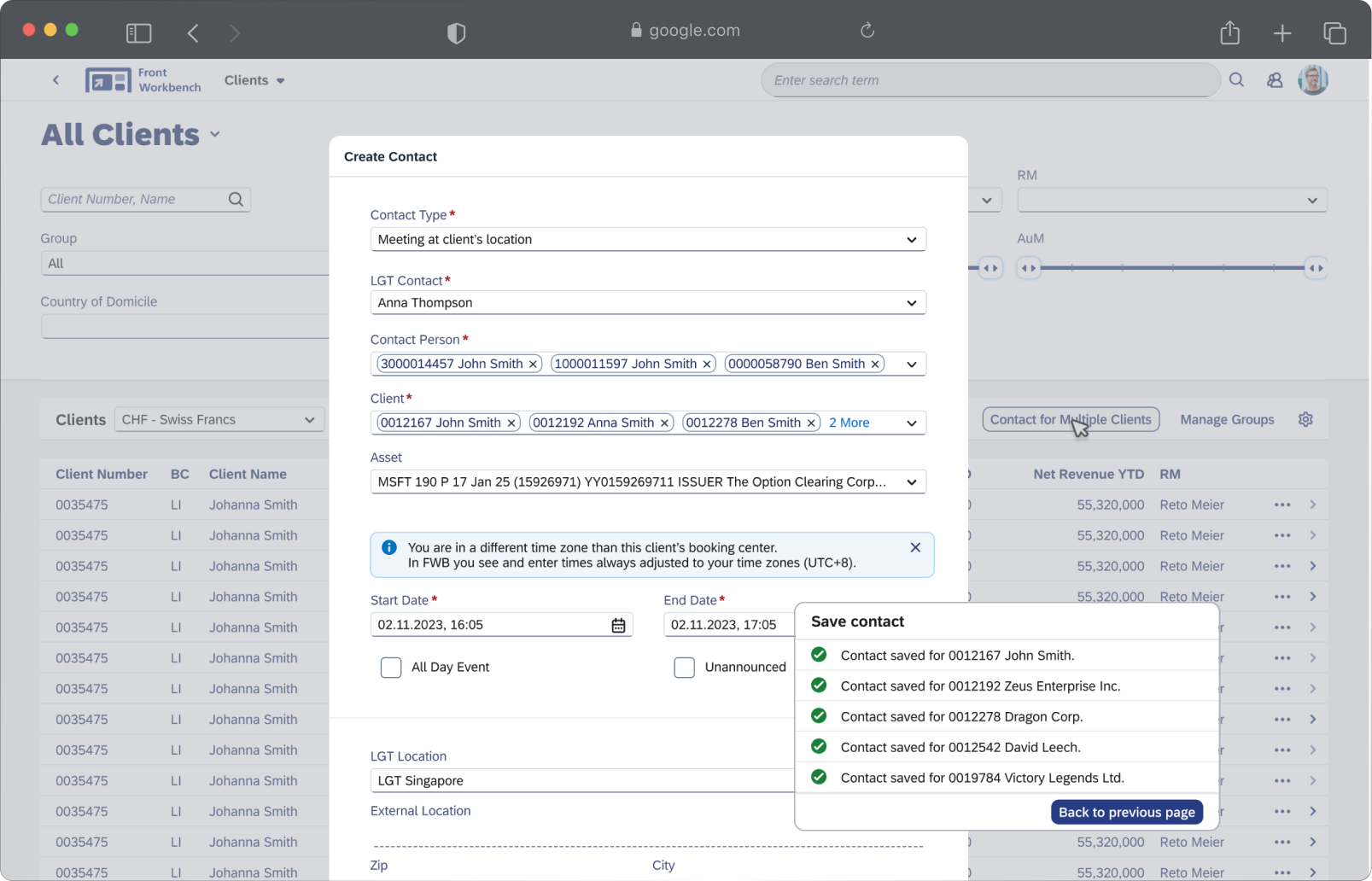
Contact log
Simultaneously creating one contact log – to be saved onto several clients’ accounts at the same time
LGT Private BankFront Workbench
UX/UI Designer (APAC lead)
Search
Optimises search to find client records in seconds


Overview
With its headquarters in Liechtenstein, one of the smallest countries in Europe, LGT, is the largest royal family-owned private banking and asset management group in the world. Front Workbench was to be the private bank’s signature internal platform – combining all internal apps from the LGT eco-system into one single app used across Europe and Asia for front office staff.I was one of a team of four designers (1 in APAC, 3 in Europe) who was brought onboard to help create a platform that was to be the go-to-tool for Relationship Managers and their assistants so that they could track and monitor their clients’ accounts and activites. To entice the Private Bank’s 500+ RMs to use yet another new system is the biggest challenge, especially since the old system will not be demised. The difference in needs between the users of the two regions also meant different applications would need to be built to cater for the different requirements.
Role:
UX/UI Designer
User research
System audit
Prototyping
User testing
Usability testing
Team:
Product ownersSolution architectFull stack devs
Software tester
Local topic owners
Duration:
4 months
- Discover
Research and feedback revealed these key issues:
One of the most critical pain points users faced was the inefficient search functionality. The current search feature lacked proper indexing, leading to slow and inaccurate results. For example, searching for a name like "Eric" would display hundreds of irrelevant entries—even when the user knew only one client by that name existed in their records.
Through user interviews and a heuristic audit of the existing app, we identified key gaps in the search experience. Competitor analysis further highlighted how other platforms handled advanced filtering and search enhancements, revealing clear opportunities for improvement.
Redesign Goals
To build a viable MVP, we prioritized making search functional at a foundational level. After initial findings from both APAC and EMEA, the decision was to focus on ensuring users could reliably find clients by name and position. Our key objectives were:
- Improve speed and accuracy by refining search indexing.
- Minimize irrelevant results through better filtering.
- Lay the groundwork for future enhancements like advanced filters or predictive search.
User interviews
To gain an understanding of:
- what are the pain points of the current search function in the core banking app
- what ‘work around’ methods are being used to complete searches
- what are the end goals of each keyword search
Competitor analysis
To gain an understanding of:
- how search is being executed in the competitive landscape
- how advanced features are being used in other products
Customer journey mapping
To gain an understanding of:
- users’ current pain points
- user’s needs, goals and motivations
- user’s touch points and interactions
So that I can:
- identify capabilities to further enhance the user experience to the product
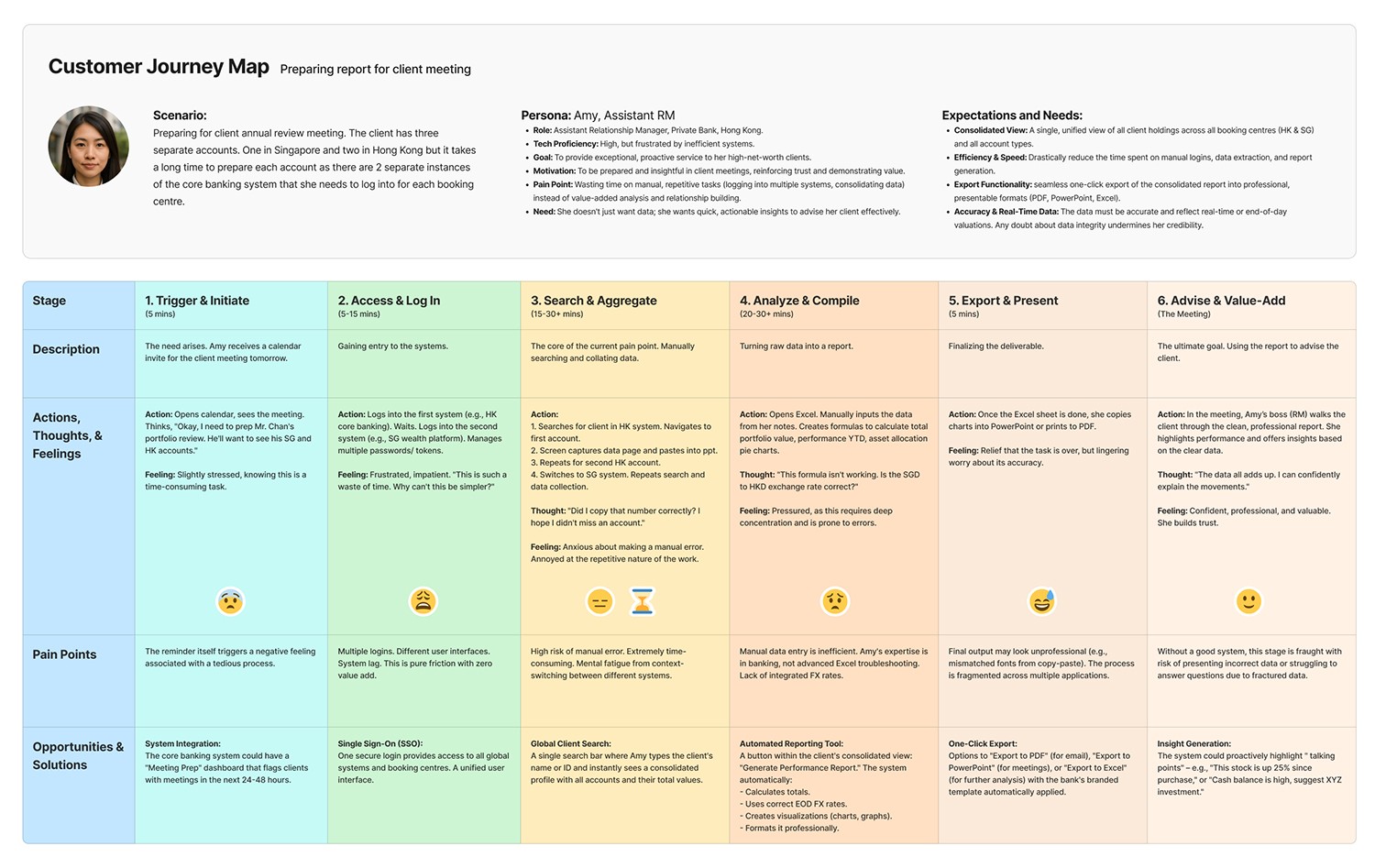
Customer Journey Map
Understanding the current process, identifying pain points and opportunities for improvement.
Prioritization Matrix
Aligning the team and stakeholders on the MVP scope after identifying key search enhancing features based on user testing feedback.
- Define
Selecting main areas of focus for Search based on the research and ideation phase:
Finding issuers and positions quickly is slow and inefficient, especially if clients have more than one account in different countries
Problem #1
Finding a client’s name, in order to track their portfolio or to retrieve other personal details, is an arduous task
Problem #2
Searching for a client’s name with a phone number is challenging because the current system isn’t indexed to search by numbers
Problem #3
Mapping the current search for clients process flow
Analysing the existing journey for informing clients about corporate actions
“If I am looking for quick information on just one bond, I have to open bond finder, punch ISIN, generate pdf, save pdf and then use pdf. It’s cumbersome...”
- Develop
Based on research insights, I developed wireframes to explore various search refinement approaches and validated them through usability testing.
Advanced search - filter chips
Advanced search - dropdown filter
- Deliver
For Front Workbench’s search functionality, the MVP launch focused on the essentials: enabling users to quickly locate clients and contacts by name. This foundational feature streamlined workflows for front office staff, allowing them to retrieve key information without further manual sifting.
Based on direct feedback from users, the post-MVP enhancement prioritised position-based search—a frequently requested capability especially for handy for dealing with corporate actions. Collaborating closely with the engineering team, we expanded the search algorithm to index and prioritise position data, aligning the tool with real-world hiring workflows.
The impact was immediate: user engagement with search increased by 90% after the post-MVP update, with position searches becoming the most-used filter. By addressing this need, Front Workbench not only improved efficiency for users but also reinforced its role as a platform built around user-driven innovation.
Search results page
Displayed results grouped into categories: clients, authorities and positions.
90%
adoption in 2 weeks
(vs. Avaloq’s search)
85%
first-result accuracy
(vs. <10% in Avaloq)
5x more
searches per day/user
Saved
500+ hours
in advisor time
- Next steps
Following the post-MVP launch, additional enhancements were prioritised based on ongoing user research and feedback. Key initiatives for the future roadmap include:
- Saved & Pinned Searches: Developing functionality to save recent searches and allow users to pin frequently used queries for quick access.
Recent search history and pinning search
Developing functionality to make it easier for users to save, pin, and quickly revisit frequent queries—eliminating repetitive manual input.
- Number-Based Search Optimization: Conducting user surveys across both APAC and EMEA to identify common numerical search patterns (e.g., IDs, invoice numbers) and analyse pain points in existing workflows.
Number based research findings
Finding #1
Inconsistent functionality across different platforms
Users had to learn the UX of different systems in order to navigate their way round each system.
Finding #2
Too many work arounds
It was difficult to complete a straight-forward search from existing apps.
Finding #3
Poor indexing
The search results are very much irrelevant and would result in hundreds of unmatched results. Also, much of the personal data hasn’t been migrated to the existing system so users aren’t able to search for phone numbers and email addresses.
Finding #4
Text selection disabled
For security reasons, highlighting and copying has been disabled in existing systems - making it difficult for users to complete simple tasks which would have easily been completed on an ordinary system.
Implementing enhancements for the search feature, based on these insights, would eliminate manual effort, freeing up time for users to focus on higher-value client activities.
Number search data findings
Understand the common scenarios that Front users search for using number format within LGT
Affinity map of survey results
Grouping pain points from Front users from both regions.
The primary pain point and user need from each affinity group was captured by a single, pivotal user quote.
Other features on Front Workbench:
Person view page
A holistic view of a client’s accounts on one page, eliminating hours of manual calculations
Credit
Smarter monitoring of client’s assets to prevent losses before they happen
Contact log
Simultaneously creating one contact log – to be saved onto several clients’ accounts at the same time
LGT Private BankFront Workbench
UX/UI Designer (APAC lead)
Search
Optimises search to find client records in seconds


Overview
With its headquarters in Liechtenstein, one of the smallest countries in Europe, LGT, is the largest royal family-owned private banking and asset management group in the world. Front Workbench is to be the private bank’s signature internal platform – combining all internal apps from the LGT eco-system into one single app used across Europe and Asia for front office staff.To entice the Private Bank’s 500+ RMs to use yet another new system is the biggest challenge, especially since the old system will not be demised. The difference in needs between the users of the two regions also meant different applications would need to be built to cater for the different requirements.I was one of a team of four designers (1 in APAC, 3 in Europe) who was brought onboard to help create a platform that was to be the go-to-tool for Relationship Managers and their assistants so that they could track and monitor their clients’ accounts and activites.
Role:
UX/UI Designer
User research
System audit
Prototyping
User testing
Usability testing
Team:
Product ownersSolution architectFull stack devs
Software tester
Local topic owners
Duration:
4 months
- Discover
Research and feedback revealed these key issues:
One of the most critical pain points users faced was the inefficient search functionality. The current search feature lacked proper indexing, leading to slow and inaccurate results. For example, searching for a name like "Eric" would display hundreds of irrelevant entries—even when the user knew only one client by that name existed in their records.
Through user interviews and a heuristic audit of the existing app, we identified key gaps in the search experience. Competitor analysis further highlighted how other platforms handled advanced filtering and search enhancements, revealing clear opportunities for improvement.
Redesign Goals
To build a viable MVP, we prioritized making search functional at a foundational level. After initial findings from both APAC and EMEA, the decision was to focus on ensuring users could reliably find clients by name and position. Our key objectives were:
- Improve speed and accuracy by refining search indexing.
- Minimize irrelevant results through better filtering.
- Lay the groundwork for future enhancements like advanced filters or predictive search.
User interviews
To gain an understanding of:
- what are the pain points of the current search function in the core banking app
- what ‘work around’ methods are being used to complete searches
- what are the end goals of each keyword search
Competitor analysis
To gain an understanding of:
- how search is being executed in the competitive landscape
- how advanced features are being used in other products
Customer journey mapping
To gain an understanding of:
- users’ current pain points
- user’s needs, goals and motivations
- user’s touch points and interactions
So that I can:
- identify capabilities to further enhance the user experience to the product
Customer Journey Map
Understanding the current process, identifying pain points and opportunities for improvement.
Prioritization Matrix
Aligning the team and stakeholders on the MVP scope after identifying key search enhancing features based on user testing feedback.
- Define
Selecting main areas of focus for Search based on the research and ideation phase:
Problem #1
Finding issuers and positions quickly is slow and inefficient, especially if clients have more than one account in different countries
Problem #2
Finding a client’s name, in order to track their portfolio or to retrieve other personal details, is an arduous task
Problem #3
Searching for a client’s name with a phone number is challenging because the current system isn’t indexed to search by numbers
Mapping the current search for clients process flow
Analysing the existing journey for informing clients about corporate actions
“If I am looking for quick information on just one bond, I have to open bond finder, punch ISIN, generate pdf, save pdf and then use pdf. It’s cumbersome...”
- Develop
Based on research insights, I developed wireframes to explore various search refinement approaches and validated them through usability testing.
Advanced search - filter chips
Advanced search - dropdown filter
- Deliver
For Front Workbench’s search functionality, the MVP launch focused on the essentials: enabling users to quickly locate clients and contacts by name. This foundational feature streamlined workflows for front office staff, allowing them to retrieve key information without further manual sifting.
Based on direct feedback from users, the post-MVP enhancement prioritised position-based search—a frequently requested capability especially for handy for dealing with corporate actions. Collaborating closely with the engineering team, we expanded the search algorithm to index and prioritise position data, aligning the tool with real-world hiring workflows.
The impact was immediate: user engagement with search increased by 90% after the post-MVP update, with position searches becoming the most-used filter. By addressing this need, Front Workbench not only improved efficiency for users but also reinforced its role as a platform built around user-driven innovation.
Search results page
Displayed results grouped into categories: clients, authorities and positions.
90%
adoption in 2 weeks
(vs. Avaloq’s search)
85%
first-result accurancy
(vs. <10% in Avaloq)
5x more
searches per day/user
Saved
500+ hours
in advisor time
- Next steps
Following the post-MVP launch, additional enhancements were prioritised based on ongoing user research and feedback. Key initiatives for the future roadmap include:
- Saved & Pinned Searches: Developing functionality to save recent searches and allow users to pin frequently used queries for quick access.
Recent search history and pinning search
Developing functionality to make it easier for users to save, pin, and quickly revisit frequent queries—eliminating repetitive manual input.
- Number-Based Search Optimization: Conducting user surveys across both APAC and EMEA to identify common numerical search patterns (e.g., IDs, invoice numbers) and analyse pain points in existing workflows.
Number based research findings
Finding #1
Inconsistent functionality across different platforms
Users had to learn the UX of different systems in order to navigate their way round each system.
Finding #2
Too many work arounds
It was difficult to complete a straight-forward search from existing apps.
Finding #3
Poor indexing
The search results are very much irrelevant and would result in hundreds of unmatched results. Also, much of the personal data hasn’t been migrated to the existing system so users aren’t able to search for phone numbers and email addresses.
Finding #4
Text selection disabled
For security reasons, highlighting and copying has been disabled in existing systems - making it difficult for users to complete simple tasks which would have easily been completed on an ordinary system.
Implementing enhancements for the search feature, based on these insights, would eliminate manual effort, freeing up time for users to focus on higher-value client activities.
Number search data findings
Understand the common scenarios that Front users search for using number format within LGT
Affinity map of survey results
Grouping pain points from Front users from both regions.
The primary pain point and user need from each affinity group was captured by a single, pivotal user quote.
Other features on Front Workbench:
Person view page
A holistic view of a client’s accounts on one page, eliminating hours of manual calculations
Credit
Smarter monitoring of client’s assets to prevent losses before they happen
Contact log
Simultaneously creating one contact log – to be saved onto several clients’ accounts at the same time